

REFLECTION AND DISCUSSION
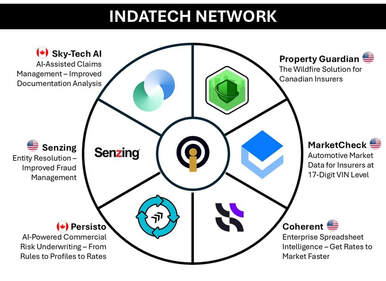
July 5, 2026 - 25 Years ago, following more than a decade of actuarial and data-related work, I started Indatech Consulting Services to provide insurance data & technology services to the Canadian P&C insurance industry. Over the last two and a half decades, I’ve worked in a consulting capacity with more than 20 clients and have also intermittently taken on full-time business development roles with various organizations bringing innovative solutions to the Canadian market.
From early beginnings of actuarial work with the Insurance Bureau of Canada, I developed an appreciation for the variety of the work involved in this industry working across all lines of business and with all segments of insurance operations, while working with insurers from coast to coast.
I always had a vision of one day Indatech being able to bring a variety of leading-edge data and technology services to the industry while working closely within the insurance ecosystem and having regular conversations about the direction of the market and the priorities of the day.
Over the last year, while continuing to work on data and actuarial projects with individual clients and having regular conversations with industry leaders, I’ve been engaging with many service providers to learn about their solutions and build a diverse network of offerings to meet the needs of the market.
Engagements with these organizations has also been a learning experience increasing my knowledge of new solutions and technology. I once heard a quote from Walter Matthau in a movie saying “There’s no such thing as too late. That’s why they invented death!”
The Indatech Network continues to grow, and several other established relationships with interesting services already exist beyond this list. Whichever side on the equation you’re on, whether looking for a solution for a specific business need, or if you’re looking to promote your solution, I’m always happy have a chat. Please reach out anytime.
View on LinkedIn.
From early beginnings of actuarial work with the Insurance Bureau of Canada, I developed an appreciation for the variety of the work involved in this industry working across all lines of business and with all segments of insurance operations, while working with insurers from coast to coast.
I always had a vision of one day Indatech being able to bring a variety of leading-edge data and technology services to the industry while working closely within the insurance ecosystem and having regular conversations about the direction of the market and the priorities of the day.
Over the last year, while continuing to work on data and actuarial projects with individual clients and having regular conversations with industry leaders, I’ve been engaging with many service providers to learn about their solutions and build a diverse network of offerings to meet the needs of the market.
Engagements with these organizations has also been a learning experience increasing my knowledge of new solutions and technology. I once heard a quote from Walter Matthau in a movie saying “There’s no such thing as too late. That’s why they invented death!”
The Indatech Network continues to grow, and several other established relationships with interesting services already exist beyond this list. Whichever side on the equation you’re on, whether looking for a solution for a specific business need, or if you’re looking to promote your solution, I’m always happy have a chat. Please reach out anytime.
View on LinkedIn.

MAY 1, 2026 - What do buyer’s remorse and insurance company headaches have in common?
Could be a vehicle reported stolen in New Brunswick and then sold to an unsuspecting customer in Manitoba.
Could be a vehicle that suffered flood damage in Florida and then sold to an unsuspecting customer in Alberta.
The best way to avoid this is to not allow the vehicle to be sold in the first place. Sometimes branded vehicles get “hidden” by moving them cross-country or even cross-border.
Identify the branded vehicle sitting on the dealer lot anywhere in North America before the consumer is even looking at it or it gets into the insurance system.
There are North American branded vehicles and dealer inventory databases available and updated daily. Why not match these 2 data sources and get those vehicles off the dealer lots as soon as possible?
Seems like this type of communication between data sources would be of interest to consumer protection groups, the insurance industry and law enforcement.
Eliminate the problem before it happens.
Now, when you eliminate a problem before it happens, how do you measure success? That’s a story for another day, but a good problem to have.
More to come later...
View on LinkedIn.
Could be a vehicle reported stolen in New Brunswick and then sold to an unsuspecting customer in Manitoba.
Could be a vehicle that suffered flood damage in Florida and then sold to an unsuspecting customer in Alberta.
The best way to avoid this is to not allow the vehicle to be sold in the first place. Sometimes branded vehicles get “hidden” by moving them cross-country or even cross-border.
Identify the branded vehicle sitting on the dealer lot anywhere in North America before the consumer is even looking at it or it gets into the insurance system.
There are North American branded vehicles and dealer inventory databases available and updated daily. Why not match these 2 data sources and get those vehicles off the dealer lots as soon as possible?
Seems like this type of communication between data sources would be of interest to consumer protection groups, the insurance industry and law enforcement.
Eliminate the problem before it happens.
Now, when you eliminate a problem before it happens, how do you measure success? That’s a story for another day, but a good problem to have.
More to come later...
View on LinkedIn.

APRIL 10, 2026 - First, welcome back to earth Artemis II crew! Loved the new views of Earth and the Moon.
My industry friends and colleagues know I like to tell stories, and that I’m an insurance data buff. Yes, that sounds boring on the surface, but I like to create stories from data. These aren't exactly what you would call case studies, but rather case stories.
I don’t use AI or external editors to write my stories, so I take full responsibility for bad grammar or poorly expressed thoughts.
Last October, just as the Blue Jays were embarking on a wild World Series Run, I started to put together a short newsletter – REAL Insights. I recently released the latest (9th) issue, and thought I’d do a quick recap.
1️⃣ October baseball was set to start (the Blue Jays brought excitement for the entire country), but baseball statistics may not always be defined the way you think they are. Just like insurance metrics.
2️⃣ You should fix the cracks in your data foundation before you start laying new bricks (technology) on top of it, thus avoiding frustration later on.
3️⃣ Avoid data bottlenecks caused by situations where one source says A=B, another says B=C, but a third source says that A ≠ C. Result: concerns about your data foundation that could simply be a “B” definition issue.
4️⃣ This was a retro issue. A string of numbers can always tell a story. I used Pink Floyd’s “Dark Side of the Moon” to relate how a good story can be created just from a string of numbers.
5️⃣ The holidays were coming up, and one outlet chose “6-7” as it’s word of the year. I chose “transformation” for the insurance industry, which was probably the word of the decade.
6️⃣ It’s the “Year of the Horse”. Could you imagine a world without horses before all the new technology mankind invented came along? This was one of my favourite stories to write.
7️⃣ As a science fiction buff, I used an Astrophysics angle to relate a story about finding your “L”. That one variable that creates the most uncertainty. Every insurance risk rating formula has an “L”. (Shoutout to the Artemis II crew)
8️⃣ You might have a great product but might need the right partnership to differentiate yourself from the competition. Remember when Chocolate and Peanut Butter came together? The rest is history.
9️⃣ With all the white noise of insurance data and technology, you’ll need more than a “Message in a Bottle” to bring about clarity to the industry.
All issues available here: REAL INSIGHTS
I’m always happy to receive any comments, good or bad. Happy reading.
View on LinkedIn.
My industry friends and colleagues know I like to tell stories, and that I’m an insurance data buff. Yes, that sounds boring on the surface, but I like to create stories from data. These aren't exactly what you would call case studies, but rather case stories.
I don’t use AI or external editors to write my stories, so I take full responsibility for bad grammar or poorly expressed thoughts.
Last October, just as the Blue Jays were embarking on a wild World Series Run, I started to put together a short newsletter – REAL Insights. I recently released the latest (9th) issue, and thought I’d do a quick recap.
1️⃣ October baseball was set to start (the Blue Jays brought excitement for the entire country), but baseball statistics may not always be defined the way you think they are. Just like insurance metrics.
2️⃣ You should fix the cracks in your data foundation before you start laying new bricks (technology) on top of it, thus avoiding frustration later on.
3️⃣ Avoid data bottlenecks caused by situations where one source says A=B, another says B=C, but a third source says that A ≠ C. Result: concerns about your data foundation that could simply be a “B” definition issue.
4️⃣ This was a retro issue. A string of numbers can always tell a story. I used Pink Floyd’s “Dark Side of the Moon” to relate how a good story can be created just from a string of numbers.
5️⃣ The holidays were coming up, and one outlet chose “6-7” as it’s word of the year. I chose “transformation” for the insurance industry, which was probably the word of the decade.
6️⃣ It’s the “Year of the Horse”. Could you imagine a world without horses before all the new technology mankind invented came along? This was one of my favourite stories to write.
7️⃣ As a science fiction buff, I used an Astrophysics angle to relate a story about finding your “L”. That one variable that creates the most uncertainty. Every insurance risk rating formula has an “L”. (Shoutout to the Artemis II crew)
8️⃣ You might have a great product but might need the right partnership to differentiate yourself from the competition. Remember when Chocolate and Peanut Butter came together? The rest is history.
9️⃣ With all the white noise of insurance data and technology, you’ll need more than a “Message in a Bottle” to bring about clarity to the industry.
All issues available here: REAL INSIGHTS
I’m always happy to receive any comments, good or bad. Happy reading.
View on LinkedIn.

APRIL 8, 2026 - Today’s insurance data and technology sphere is generating a lot of white noise. But you don’t have to navigate through it by yourself. We have answers.
Do you wonder if you’re managing your natural hazard exposures properly? Are you addressing the needs of OSFI’s B-15 Guideline on Climate Risk Management? We have answers.
Is your organization drowning in Excel Spreadsheets and you’re looking for ways to accelerate rate change implementations? We have answers.
Do you know about Entity Resolution and how it can help you fight fraud? How many variations of names and addresses and relevant historical information are in your own files, let alone in accessible external databases? We have answers.
Would you like more vehicle information at the 17-digit level to get a leg up on your competition by knowing the claims experience of vehicles with detailed option specs? We have answers.
Would you like to know what dealers are stocking and moving the types of vehicles you would prefer to insure? Are you thinking about participating in the new Ontario program that allows auto dealerships to sell insurance at the point of sale with an alliance with licensed brokers and agents? Which dealers offer the type of inventory and vehicle turnover that is most attractive to your marketing strategy? We have answers.
Are you concerned about the Care-first changes coming to Alberta in 2027 and how you’ll deal with the thousands of pages of medical and legal claims documents you’ll need to deal with? Can AI help? We have answers.
Are you training your underwriters to use AI to build detailed risk profiles, but would like a faster way to help your team get there? We have answers.
Are you wondering what pre-existing environmental risks might exist under or around your current or potential insured exposures? We have answers.
Do you just need some extra data management or certified actuarial support? We have answers.
You don’t need to navigate through all the white noise by yourself. If you find yourself caught in a maze of new insurance data and technology services, look for Indatech Clarity.
Reach out and let’s talk about your needs.
View on LinkedIn.
Do you wonder if you’re managing your natural hazard exposures properly? Are you addressing the needs of OSFI’s B-15 Guideline on Climate Risk Management? We have answers.
Is your organization drowning in Excel Spreadsheets and you’re looking for ways to accelerate rate change implementations? We have answers.
Do you know about Entity Resolution and how it can help you fight fraud? How many variations of names and addresses and relevant historical information are in your own files, let alone in accessible external databases? We have answers.
Would you like more vehicle information at the 17-digit level to get a leg up on your competition by knowing the claims experience of vehicles with detailed option specs? We have answers.
Would you like to know what dealers are stocking and moving the types of vehicles you would prefer to insure? Are you thinking about participating in the new Ontario program that allows auto dealerships to sell insurance at the point of sale with an alliance with licensed brokers and agents? Which dealers offer the type of inventory and vehicle turnover that is most attractive to your marketing strategy? We have answers.
Are you concerned about the Care-first changes coming to Alberta in 2027 and how you’ll deal with the thousands of pages of medical and legal claims documents you’ll need to deal with? Can AI help? We have answers.
Are you training your underwriters to use AI to build detailed risk profiles, but would like a faster way to help your team get there? We have answers.
Are you wondering what pre-existing environmental risks might exist under or around your current or potential insured exposures? We have answers.
Do you just need some extra data management or certified actuarial support? We have answers.
You don’t need to navigate through all the white noise by yourself. If you find yourself caught in a maze of new insurance data and technology services, look for Indatech Clarity.
Reach out and let’s talk about your needs.
View on LinkedIn.

MARCH 28, 2026 - I heard something disturbing today while listening to a US network who was conducting an interview with Kip Tom, former United States Ambassador to the United Nations Agencies for Food and Agriculture (2019-2021).
They were discussing some of the issues US farmers are having with a potential shortage of nitrogen fertilizer, due to the current events going on in the Middle East.
The discussion then moved to potash, which the US gets the majority of its supply of from Canada. Mr. Tom went on to discuss the reliance on Canada for potash and that it may be time to look at other sources, mentioning that Russia and Belarus (yes, those are the 2 countries he mentioned) were large producers of potash.
He also mentioned that the Belarus leader was expected to be meeting with the administration in the near future. I looked this up a bit more afterwards, and there are apparently some reports of future talks aimed at thawing relations between the 2 countries, even mentioning that Belarus was looking for a “big deal”.
I know the US administration was somewhat critical of Canada having trade discussions with China, but let’s hope this is not part of the planned solution.
It’s time to settle the trade issues between our 2 countries. You should be able to rely on your closest friend and neighbour (with the world’s longest unguarded border), without having to enter into questionable unnecessary relationships.
When you need a supply of morning coffee, you won’t call Canada, but when you need maple syrup for your morning pancakes, who you gonna call? 😊
View on LinkedIn.
They were discussing some of the issues US farmers are having with a potential shortage of nitrogen fertilizer, due to the current events going on in the Middle East.
The discussion then moved to potash, which the US gets the majority of its supply of from Canada. Mr. Tom went on to discuss the reliance on Canada for potash and that it may be time to look at other sources, mentioning that Russia and Belarus (yes, those are the 2 countries he mentioned) were large producers of potash.
He also mentioned that the Belarus leader was expected to be meeting with the administration in the near future. I looked this up a bit more afterwards, and there are apparently some reports of future talks aimed at thawing relations between the 2 countries, even mentioning that Belarus was looking for a “big deal”.
I know the US administration was somewhat critical of Canada having trade discussions with China, but let’s hope this is not part of the planned solution.
It’s time to settle the trade issues between our 2 countries. You should be able to rely on your closest friend and neighbour (with the world’s longest unguarded border), without having to enter into questionable unnecessary relationships.
When you need a supply of morning coffee, you won’t call Canada, but when you need maple syrup for your morning pancakes, who you gonna call? 😊
View on LinkedIn.

MARCH 13, 2026 - This short story is about navigating through the white noise of InsurTech. If curious, read on.
25 years ago, I set up Indatech, which stands for Insurance Data and Technology. Prior to Indatech, I spent more than 10 years in Actuarial, Marketing and Operations roles.
The next 25 years included a mix of consulting work and full-time engagements with insurers, associations and service providers.
One constant, however, has been the young industry professionals, including the many actuaries I got to know and call friends along the way. Whether I was working on statistical plan submissions while at IBC or on the implementation of CLEAR Rate Groups while at VICC, these tasks were typically assigned to the company’s young actuaries. These young professionals have since grown into leadership roles all across the industry.
Yes, I’ve taken advantage of those relationships over the years whether working in consulting roles or assisting service providers bring their message to the industry. As an example, over these years, I’ve worked with six different U.S.-based service providers in a variety of Canadian business development roles.
With a public profile, this doesn’t go unnoticed, and just in the last 6 months since returning to full-time independent work, I’ve been approached by many organizations from Canada, the U.S. and Europe looking for market intel and introductions to expand their service offerings in the Canadian market. I’ve also been given access to several test environments so I can test out the products myself.
Yes, I’m an independent, and although I may be in the minority, I enjoy talking insurance.
Whether you want to talk about hazard modeling, exposure management, entity resolution, property environmental information, using AI to manage complex claims files or build risk profiles, enterprise spreadsheet automation, or if you need some extra actuarial and data management support, I have something to share.
If you’re frustrated by all the white noise, and just want to have a chat, just reach out. Call it "InsurTech Therapy".
View on LinkedIn.
25 years ago, I set up Indatech, which stands for Insurance Data and Technology. Prior to Indatech, I spent more than 10 years in Actuarial, Marketing and Operations roles.
The next 25 years included a mix of consulting work and full-time engagements with insurers, associations and service providers.
One constant, however, has been the young industry professionals, including the many actuaries I got to know and call friends along the way. Whether I was working on statistical plan submissions while at IBC or on the implementation of CLEAR Rate Groups while at VICC, these tasks were typically assigned to the company’s young actuaries. These young professionals have since grown into leadership roles all across the industry.
Yes, I’ve taken advantage of those relationships over the years whether working in consulting roles or assisting service providers bring their message to the industry. As an example, over these years, I’ve worked with six different U.S.-based service providers in a variety of Canadian business development roles.
With a public profile, this doesn’t go unnoticed, and just in the last 6 months since returning to full-time independent work, I’ve been approached by many organizations from Canada, the U.S. and Europe looking for market intel and introductions to expand their service offerings in the Canadian market. I’ve also been given access to several test environments so I can test out the products myself.
Yes, I’m an independent, and although I may be in the minority, I enjoy talking insurance.
Whether you want to talk about hazard modeling, exposure management, entity resolution, property environmental information, using AI to manage complex claims files or build risk profiles, enterprise spreadsheet automation, or if you need some extra actuarial and data management support, I have something to share.
If you’re frustrated by all the white noise, and just want to have a chat, just reach out. Call it "InsurTech Therapy".
View on LinkedIn.

FEBRUARY 22, 2026 - Thanks to Asymmetrix for sending over an updated Flood Risk Data Providers market map.
A couple of weeks ago I posted how their published list went from 21 to 30 in a matter of a few days once providers commented on their original post. 2 weeks later the list now stands at 36.
This is just one example of how crowded the InsurTech space is. If you’re an insurance provider looking to make use of these new services, how do you navigate through all the white noise? If you’re an InsurTech providing new innovative data and technology solutions, how do you differentiate yourself and satisfy your investors?
In crowded spaces, relationships matter more than ever.
View on LinkedIn.
A couple of weeks ago I posted how their published list went from 21 to 30 in a matter of a few days once providers commented on their original post. 2 weeks later the list now stands at 36.
This is just one example of how crowded the InsurTech space is. If you’re an insurance provider looking to make use of these new services, how do you navigate through all the white noise? If you’re an InsurTech providing new innovative data and technology solutions, how do you differentiate yourself and satisfy your investors?
In crowded spaces, relationships matter more than ever.
View on LinkedIn.

FEBRUARY 4, 2026 - I've worked in the insurance industry for more than 3 decades starting as a young actuary for a national industry association. Whenever we thought we had seen everything there was to see, something new always came along. It’s what kept the industry interesting. In recent years, hot topics have been around cyber, climate change, driverless cars, ride-share programs, short-term rentals, and so on.
We’re now in the world of InsurTech, where new players emerge so fast, it’s hard to keep track. As an example, Asymmetrix recently produced the graphics below. Within a few days of posting the first one, “missing” players commented on the post, and a new graphic came out. The number of identified players in the “Flood Risk Data Providers” space went from 21 to 30 in a matter of a few days.
Whether you’re in this specific InsurTech space or another one, the question is how do you differentiate yourself? That’s when relationships matter.
Spaces are getting crowded and relationships matter more than ever, and you’ll need more than AI to get your message out. Otherwise, you're just part of the white noise.
View on LinkedIn.
We’re now in the world of InsurTech, where new players emerge so fast, it’s hard to keep track. As an example, Asymmetrix recently produced the graphics below. Within a few days of posting the first one, “missing” players commented on the post, and a new graphic came out. The number of identified players in the “Flood Risk Data Providers” space went from 21 to 30 in a matter of a few days.
Whether you’re in this specific InsurTech space or another one, the question is how do you differentiate yourself? That’s when relationships matter.
Spaces are getting crowded and relationships matter more than ever, and you’ll need more than AI to get your message out. Otherwise, you're just part of the white noise.
View on LinkedIn.

FEBRUARY 3, 2026 - Relationships and critical thinking are more important than ever.
Don’t be part of the white noise. If you’re an InsurTech trying to get your message out, you know you’re in a crowded space that’s getting more congested every day. You may have the best solution in the market, but getting your message out to potential clients requires strong relationships with people that will be willing to listen to you and trust your opinions. Otherwise, you’re just white noise.
Mind the gap. If you’re an organization looking to implement an AI Assistant, whether for claims, underwriting, marketing or pricing, you need to ensure you select the solutions that will promote critical thinking within your team and not replace it. Your leaders of tomorrow are in the trenches today and you need to give them the tools that will help them grow into those leaders. Otherwise, you’ll end up with a gap in critical thinking.
When industry leaders made their predictions for 2026, they were correct that 1) this is the year AI moves from experimentation to implementation, but also, and maybe even more important 2) critical thinking and human judgement will be more important than ever.
View on LinkedIn.
Don’t be part of the white noise. If you’re an InsurTech trying to get your message out, you know you’re in a crowded space that’s getting more congested every day. You may have the best solution in the market, but getting your message out to potential clients requires strong relationships with people that will be willing to listen to you and trust your opinions. Otherwise, you’re just white noise.
Mind the gap. If you’re an organization looking to implement an AI Assistant, whether for claims, underwriting, marketing or pricing, you need to ensure you select the solutions that will promote critical thinking within your team and not replace it. Your leaders of tomorrow are in the trenches today and you need to give them the tools that will help them grow into those leaders. Otherwise, you’ll end up with a gap in critical thinking.
When industry leaders made their predictions for 2026, they were correct that 1) this is the year AI moves from experimentation to implementation, but also, and maybe even more important 2) critical thinking and human judgement will be more important than ever.
View on LinkedIn.

JANUARY 26, 2026 - You likely see hundreds of posts regularly coming across talking about topics like “When to use AI tools”, “Gen AI basics”, “Learn how to build AI Agents”, “AI skills to learn”, “Chat GPT Cheat Sheets”, etc.
There’s no lack of information making its way around but is this the information you need to help you select the solution that’s right for you.
Industry leaders recently provided their outlook for 2026. Across the board, the top 2 priorities were that AI will be moving from experimentation to integration, and the critical importance of human judgement despite automation.
You should be looking to achieve both objectives with the solution(s) you choose to move forward with. Not only should you look to achieve more automation, but your new AI Assistant (Assistant) should be working with your team members to ensure that second priority - continuity of critical human judgement. Not only for the short term, but also the long term.
Through demos with various insurance organizations, I’ve seen and heard first-hand the value the right solution can add.
Operational Value & Accuracy: “The way the Assistant processes clinical notes and records is amazing. The way it summarizes everything is a huge need for us.”
Capacity & Hiring Impact: “The Assistant removes a significant portion of the workload from our adjusters while dramatically increasing their overall capacity.”
Strategic Fit & Adoption: “The Assistant achieves a rare balance between AI and human expertise—accelerating our work without diminishing critical judgment. The Assistant really helps with cross-training. We have high performers who want to move into other areas, and this helps to support that.”
The AI solution that’s right for you can also be a valuable hiring and training tool, as the next generation of insurance professionals will be prioritizing organizations that can equip them with the right Assistant(s) so they can grow and become the leaders of tomorrow.
I’ve seen first-hand how this can be accomplished. If you’d like to chat more about this or schedule a demo so you can see it for yourself or discuss how you could participate in one of our Advisory Groups, please reach out.
View on LinkedIn.
There’s no lack of information making its way around but is this the information you need to help you select the solution that’s right for you.
Industry leaders recently provided their outlook for 2026. Across the board, the top 2 priorities were that AI will be moving from experimentation to integration, and the critical importance of human judgement despite automation.
You should be looking to achieve both objectives with the solution(s) you choose to move forward with. Not only should you look to achieve more automation, but your new AI Assistant (Assistant) should be working with your team members to ensure that second priority - continuity of critical human judgement. Not only for the short term, but also the long term.
Through demos with various insurance organizations, I’ve seen and heard first-hand the value the right solution can add.
Operational Value & Accuracy: “The way the Assistant processes clinical notes and records is amazing. The way it summarizes everything is a huge need for us.”
Capacity & Hiring Impact: “The Assistant removes a significant portion of the workload from our adjusters while dramatically increasing their overall capacity.”
Strategic Fit & Adoption: “The Assistant achieves a rare balance between AI and human expertise—accelerating our work without diminishing critical judgment. The Assistant really helps with cross-training. We have high performers who want to move into other areas, and this helps to support that.”
The AI solution that’s right for you can also be a valuable hiring and training tool, as the next generation of insurance professionals will be prioritizing organizations that can equip them with the right Assistant(s) so they can grow and become the leaders of tomorrow.
I’ve seen first-hand how this can be accomplished. If you’d like to chat more about this or schedule a demo so you can see it for yourself or discuss how you could participate in one of our Advisory Groups, please reach out.
View on LinkedIn.

JANUARY 25, 2026 - For those who have followed some of my posts or viewed my Insights newsletter on my website, you’ll know I created the diagram below a few months ago to promote the importance of data confidence. We've all learned early on that if A=B and B=C then A=C. https://lnkd.in/gChF9umJ
But the issue is that sometimes data elements and metrics like "B" are defined and interpreted differently thus creating a situation where A is not equal to C, and chaos ensues.
When starting this discussion a few months ago, I was purely thinking of this concept from a business standpoint avoiding frustration, concerns and skepticism in using your data.
But from some of the events of recent weeks, you can see this can also apply to everyday life when the red bin interpretes "B" differently than the blue bin.
The result is A ≠ C. So, frustration, concerns and skepticism, or rather chaos ensues.
View on LinkedIn.
But the issue is that sometimes data elements and metrics like "B" are defined and interpreted differently thus creating a situation where A is not equal to C, and chaos ensues.
When starting this discussion a few months ago, I was purely thinking of this concept from a business standpoint avoiding frustration, concerns and skepticism in using your data.
But from some of the events of recent weeks, you can see this can also apply to everyday life when the red bin interpretes "B" differently than the blue bin.
The result is A ≠ C. So, frustration, concerns and skepticism, or rather chaos ensues.
View on LinkedIn.

JANUARY 19, 2026 - Canada has had more than one “whisky war” in the last few years.
More recently, in 2025, it involved taking U.S. Bourbon off the shelves in Canadian liquor stores because of tariffs.
But before that, there was a more peaceful ending to another one with Denmark over the tiny Hans Island.
True story. Excerpt from a story by the Canadian Press (June 14, 2022):
[Canadian Foreign Affairs Minister Melanie] Joly hailed the signing as a “historic day,” adding that it ended the “friendliest of all wars” which involved both nations leaving bottles of spirits on the island with little notes for one another while removing each other’s flags.
After the signing of the deal, the foreign ministers symbolically exchanged bottles of spirits, with notes attached, to end the “whisky war.”
View on LinkedIn.
More recently, in 2025, it involved taking U.S. Bourbon off the shelves in Canadian liquor stores because of tariffs.
But before that, there was a more peaceful ending to another one with Denmark over the tiny Hans Island.
True story. Excerpt from a story by the Canadian Press (June 14, 2022):
[Canadian Foreign Affairs Minister Melanie] Joly hailed the signing as a “historic day,” adding that it ended the “friendliest of all wars” which involved both nations leaving bottles of spirits on the island with little notes for one another while removing each other’s flags.
After the signing of the deal, the foreign ministers symbolically exchanged bottles of spirits, with notes attached, to end the “whisky war.”
View on LinkedIn.

JANUARY 14, 2026 - Let’s create a story. An InsurTech journey seems to follow pretty closely the tracks of Pink Floyds’ classic 1973 The Dark Side of the Moon.
Track 1 - “Speak to Me” – An idea came to me for a new product.
Track 2 - “Breathe (In the Air)” – Let’s do research and gather the information.
Track 3 - “On the Run” – We have enough to get started. Let’s run with it.
Track 4 - “Time” – This is going to take a lot more time than we thought.
Track 5 - “The Great Gig in the Sky” – This will be great. Everyone will want it.
Track 6 - “Money” – We need more capital, another round of funding.
Track 7 - “Us and Them” – Looks like we have competition.
Track 8 - “Any Colour You Like” – We can customize. That’s our advantage.
Track 9 - “Brain Damage” – This is not easy. I’m getting burnt out.
Track 10 - “Eclipse” – Everything is going dark. Wait, the Sun’s coming out!
It’s always fun to create stories. In this case it's like putting an idea through a prism and seeing all the colours come out on the other side. I wonder if this is what Pink Floyd was thinking in 1973.
View on LinkedIn.
Track 1 - “Speak to Me” – An idea came to me for a new product.
Track 2 - “Breathe (In the Air)” – Let’s do research and gather the information.
Track 3 - “On the Run” – We have enough to get started. Let’s run with it.
Track 4 - “Time” – This is going to take a lot more time than we thought.
Track 5 - “The Great Gig in the Sky” – This will be great. Everyone will want it.
Track 6 - “Money” – We need more capital, another round of funding.
Track 7 - “Us and Them” – Looks like we have competition.
Track 8 - “Any Colour You Like” – We can customize. That’s our advantage.
Track 9 - “Brain Damage” – This is not easy. I’m getting burnt out.
Track 10 - “Eclipse” – Everything is going dark. Wait, the Sun’s coming out!
It’s always fun to create stories. In this case it's like putting an idea through a prism and seeing all the colours come out on the other side. I wonder if this is what Pink Floyd was thinking in 1973.
View on LinkedIn.

JANUARY 11, 2026 - Mind the gap.
The 2026 outlook from industry leaders put a lot of emphasis on AI moving from experimentation to integration, followed by the critical importance of human judgement despite automation.
Considering the insurance claims process, as an example, the continuity of critical human judgement could easily get overlooked. In the short term, with competitive pressures, the automation piece will get done to use the technology to reduce the administrative burden of reviewing and summarizing medical records, diaries, legal and other documents, while also providing new insights and allowing senior leaders to focus on the more complex files. The process of integrating AI technology with the right questions, or prompts, will be a reiterative one, but it will continue to progress.
Also in the short term, experienced resources to handle the oversight and management of complex files in addition to the overall Claims operations will be available. These resources have gone through the learning curve to make them leaders in their field, having gone through the traditional steps of learning on the job.
But as the technology evolves and takes over many of the “learn on the job” tasks, if there’s a reduced need for junior resources, years from now, where will the experienced resources come from? This is where the continuity gap of human judgement could start appearing if not addressed.
In addition to the desired improvements in efficiencies automation will bring, your new AI “assistant” should also be able to work in tandem with your team members, so they can develop into the senior leaders of tomorrow and maintain that valuable human judgement continuity.
When selecting your AI-enabled solutions, “Mind the gap”.
View on LinkedIn or learn more about your new Claims Assistant by visiting Sky AI.
The 2026 outlook from industry leaders put a lot of emphasis on AI moving from experimentation to integration, followed by the critical importance of human judgement despite automation.
Considering the insurance claims process, as an example, the continuity of critical human judgement could easily get overlooked. In the short term, with competitive pressures, the automation piece will get done to use the technology to reduce the administrative burden of reviewing and summarizing medical records, diaries, legal and other documents, while also providing new insights and allowing senior leaders to focus on the more complex files. The process of integrating AI technology with the right questions, or prompts, will be a reiterative one, but it will continue to progress.
Also in the short term, experienced resources to handle the oversight and management of complex files in addition to the overall Claims operations will be available. These resources have gone through the learning curve to make them leaders in their field, having gone through the traditional steps of learning on the job.
But as the technology evolves and takes over many of the “learn on the job” tasks, if there’s a reduced need for junior resources, years from now, where will the experienced resources come from? This is where the continuity gap of human judgement could start appearing if not addressed.
In addition to the desired improvements in efficiencies automation will bring, your new AI “assistant” should also be able to work in tandem with your team members, so they can develop into the senior leaders of tomorrow and maintain that valuable human judgement continuity.
When selecting your AI-enabled solutions, “Mind the gap”.
View on LinkedIn or learn more about your new Claims Assistant by visiting Sky AI.

JANUARY 9, 2026 - “A society grows great when old men plant trees, the shade of which they know they will never sit in.”
I recently heard this quote and thought of the impact AI will be having on the insurance industry, specifically in the Claims area.
When you ask insurance leaders about their outlook for 2026, the list usually starts with 1) this will be the year when AI moves from experimentation to integration, and 2) human judgement will remain critical despite automation.
Claims are typically document-intensive, but never more than when handling Accident Benefits (AB) and Liability claims, with reviews of medical records, diaries and legal records. The ever-evolving auto insurance product always presents challenges and new regulations and standards to abide by. And more changes are coming to the Ontario and Alberta products over the next year, posing new challenges.
IT’S TIME TO BRING IN A NEW CLAIMS ASSISTANT (CA)
The claims handling process will see a shift in the coming years, with a new CA to help alleviate some of the administrative burden of these tasks, allowing the more experienced adjusters and claims leaders to focus on the type of files that require more judgement.
The new CA will provide immediate benefits and relief from much of the administrative burden and be able to provide new insights, but you will always need senior claims professionals to provide that valuable human judgement on the more complex files. Remember, however, that these experienced professionals were once juniors. The CA shouldn’t eliminate the junior claims handlers, but rather, they should be working together.
If you’d like to see an AI Claims Assistant in action, please reach out and we can discuss further. We have a solution that's ready today.
Think of your claims team as a society.
View on LinkedIn or learn more about your new Claims Assistant by visiting Sky AI.
I recently heard this quote and thought of the impact AI will be having on the insurance industry, specifically in the Claims area.
When you ask insurance leaders about their outlook for 2026, the list usually starts with 1) this will be the year when AI moves from experimentation to integration, and 2) human judgement will remain critical despite automation.
Claims are typically document-intensive, but never more than when handling Accident Benefits (AB) and Liability claims, with reviews of medical records, diaries and legal records. The ever-evolving auto insurance product always presents challenges and new regulations and standards to abide by. And more changes are coming to the Ontario and Alberta products over the next year, posing new challenges.
IT’S TIME TO BRING IN A NEW CLAIMS ASSISTANT (CA)
The claims handling process will see a shift in the coming years, with a new CA to help alleviate some of the administrative burden of these tasks, allowing the more experienced adjusters and claims leaders to focus on the type of files that require more judgement.
The new CA will provide immediate benefits and relief from much of the administrative burden and be able to provide new insights, but you will always need senior claims professionals to provide that valuable human judgement on the more complex files. Remember, however, that these experienced professionals were once juniors. The CA shouldn’t eliminate the junior claims handlers, but rather, they should be working together.
If you’d like to see an AI Claims Assistant in action, please reach out and we can discuss further. We have a solution that's ready today.
Think of your claims team as a society.
View on LinkedIn or learn more about your new Claims Assistant by visiting Sky AI.

JANUARY 2, 2026 - Will AI have a Y2K moment? First, a bit of history.
The computer first arrived in the 1940s with wide mainframe usage in the 60s and 70s to handle large-scale data processing. The world was just learning how to use this new shiny toy. But to use these big machines, programming languages were created, and the computer became essential for business and government.
Throughout the 60s, 70s and 80s, programs were written and the business world was humming along. But when the 90s rolled around, Y2K reared its ugly head. If you’re old enough, you remember this was a simple issue: to save space, 2-digit years as opposed to 4 digits were used in most computer programs. The world as we knew it was so dependent on the computer, it was going to end if the problem wasn’t fixed before the stroke of midnight on December 31st, 1999.
I remember two thoughts I had at the time.
One. I was impressed that computer programs written in the 60s and 70s were still effective and operational in the late 90s. They weren’t being replaced, but rather they would be updated. At significant costs, no less. Organizations were on the hunt for programmers that still knew how to write code in languages like Assembly and COBAL. Still, it was impressive that these programs continued to be operational decades later.
Two. I was surprised that some of the programs written not so long before, some as recent as in the 80s, didn’t have the vision that a 2-digit year would be an issue in the not-so-distant future. I don’t blame the programmers. Their job was to make the program work and had limited space on the record layout to work with.
Now we turn to a new shiny toy.
Reading about the outlook for 2026 from business leaders, you’ll hear that 2026 is the year AI becomes foundational and moves from experimentation to full-scale deployment. If we fast-forward a decade or two and look back to 2026, what will impress us and what will surprise us about how we handled AI today?
Let’s avoid another Y2K situation, as the next one could prove much more costly. Yes, AI is here to stay but let’s do it right. Let’s not miss something as simple as a 4-digit year.
View on LinkedIn.
The computer first arrived in the 1940s with wide mainframe usage in the 60s and 70s to handle large-scale data processing. The world was just learning how to use this new shiny toy. But to use these big machines, programming languages were created, and the computer became essential for business and government.
Throughout the 60s, 70s and 80s, programs were written and the business world was humming along. But when the 90s rolled around, Y2K reared its ugly head. If you’re old enough, you remember this was a simple issue: to save space, 2-digit years as opposed to 4 digits were used in most computer programs. The world as we knew it was so dependent on the computer, it was going to end if the problem wasn’t fixed before the stroke of midnight on December 31st, 1999.
I remember two thoughts I had at the time.
One. I was impressed that computer programs written in the 60s and 70s were still effective and operational in the late 90s. They weren’t being replaced, but rather they would be updated. At significant costs, no less. Organizations were on the hunt for programmers that still knew how to write code in languages like Assembly and COBAL. Still, it was impressive that these programs continued to be operational decades later.
Two. I was surprised that some of the programs written not so long before, some as recent as in the 80s, didn’t have the vision that a 2-digit year would be an issue in the not-so-distant future. I don’t blame the programmers. Their job was to make the program work and had limited space on the record layout to work with.
Now we turn to a new shiny toy.
Reading about the outlook for 2026 from business leaders, you’ll hear that 2026 is the year AI becomes foundational and moves from experimentation to full-scale deployment. If we fast-forward a decade or two and look back to 2026, what will impress us and what will surprise us about how we handled AI today?
Let’s avoid another Y2K situation, as the next one could prove much more costly. Yes, AI is here to stay but let’s do it right. Let’s not miss something as simple as a 4-digit year.
View on LinkedIn.

DECEMBER 30, 2025 - As we welcome 2026, this will also mark the 150th anniversary of when Alexander Graham Bell first patented the telephone. A lot has been invented since the phone first appeared on the scene but there was always one constant before then.
Long before “Planes, Trains and Automobiles” the horse was the main source of overland transportation.
Long before telegraphs, phones and the internet, the horse was the fastest way to deliver news and information.
Long before computers and AI, the horse was your most reliable work assistant whether you were working the land or transporting goods.
The main difference between all those innovations and the horse, is they were all man-made. Is there another horse out there? Something we didn't invent that we couldn't do without in everyday life.
Think back a few centuries and try to imagine a world without horses.
Happy New Year everyone!
View on LinkedIn or see REAL INSIGHTS page for this and more stories.
Long before “Planes, Trains and Automobiles” the horse was the main source of overland transportation.
Long before telegraphs, phones and the internet, the horse was the fastest way to deliver news and information.
Long before computers and AI, the horse was your most reliable work assistant whether you were working the land or transporting goods.
The main difference between all those innovations and the horse, is they were all man-made. Is there another horse out there? Something we didn't invent that we couldn't do without in everyday life.
Think back a few centuries and try to imagine a world without horses.
Happy New Year everyone!
View on LinkedIn or see REAL INSIGHTS page for this and more stories.
Advancing the business of insurance through data and technology
© 2026 Indatech ● Toronto, Ontario, Canada ● (416) 720-1498